

April 21, 2026
Most professionals know a site assessment is a key first step for any development. What changes at the top of this industry is which questions an experienced developer carries into the process and how early they start asking them.
Think of it this way: when you started building custom homes, you were not following the exact SOPs you do today. Why not? Because you didn’t know what you didn’t know. You learned through your own experience and by listening to the right people in your network.
The transition from custom homes into development presents the same opportunity. Your first development is likely not a 100+ rooftop subdivision with multi-dimensional placemaking amenities, so it’s reasonable to say you don’t need a full scale, pre-development strategy. That’s a defensible stance. What’s not is a poorly-defined evaluation process that doesn’t act as a risk mitigation tool.
Here are the four components worth carrying into your site assessment and due diligence effort.
No. 1 | Conditions of Approval can reprice your deal
When a municipality approves a development, it absorbs the impact of what that development adds to the surrounding system. The conditions attached to that approval are the developer’s contribution to managing that impact. They are not a penalty. They are a predictable part of the entitlement process, and the builders who account for them early are the ones whose pro formas survive contact with the approval process.
Those conditions can include road widening, deceleration lanes, sidewalk extensions, and utility main extensions beyond the project boundary. The Traffic Impact Analysis, required by most municipalities above a certain unit threshold, is where new developers most commonly encounter this for the first time.
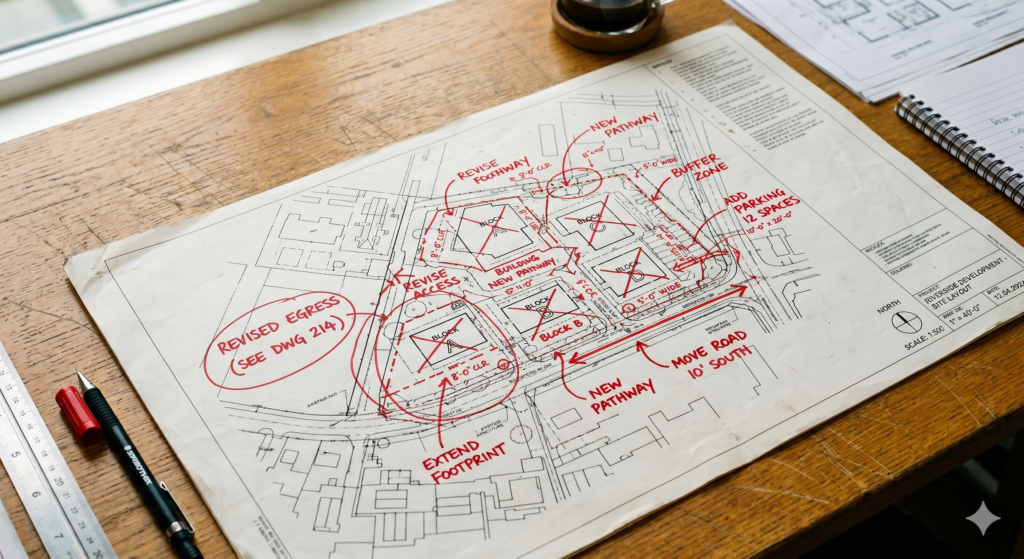
What improves your positioning upstream, is knowing what comparable projects in the same jurisdiction leave a public record. In Texas, Government Code Chapter 552, the Texas Public Information Act, gives anyone the right to request those records from a municipality, and the municipality cannot ask why you want them. Most states have equivalent public records laws. That written request tells you what conditions the municipality has attached to similar projects before you submit anything and whether those costs are reflected in what you’re paying for the land.
The Go/No-Go Question To Ask:
What have comparable projects [in this jurisdiction] been required to build, and
is that number in your pro forma?
No. 2 | Adjacent utilities is a fact, not the full answer
Knowing where utilities are is the starting point. Knowing whether they can carry the proposed load is the question that protects the deal.
A water main serving the existing neighborhood may have nothing left for a 30-lot subdivision tapping off the same point. The feasibility read looks at main size, available pressure and flow, and whether upstream upgrades are required before the municipality approves service. Sewer follows the same logic. Does the nearest gravity line have capacity, or does this project require a lift station to get there.
Lift stations are expensive to build and sometimes a condition of approval that’s not easily visible in the original underwriting. The variable worth understanding is how far adequate infrastructure is from the proposed connection, not just whether a line exists somewhere nearby.
The Go/No-Go Question To Ask:
Can the existing infrastructure carry the proposed load, and who pays if it can’t?
No. 3 | A conversation can reveal the hidden variables
Conditions of Approval and utility capacity are knowable through records and engineering analysis. What neither reveals is what the municipality will require based on the specific conditions of your site. That knowledge lives with Planning and Zoning (P&Z) staff.
Every municipality operates differently based on the conditions that exist in their community. A cursory review of publicly available data gives you part of the picture. The rest lives with the people inside the local Planning and Zoning (P&Z) department, staff who know the local codes, the local thresholds, and what a site like yours has historically triggered. A conversation with them is useful. A relationship is priceless.
Some jurisdictions require a No-Rise certification for development within a defined proximity to a floodplain – a requirement that doesn’t show up on a FEMA map. Without an early P&Z conversation, details like this surfaces in first round review comments. The certification introduces a hydrologic analysis, which can trigger a detention requirement based on the findings. A detention basin consumes land, reducing the overall lot yield. If the deal was already tight, the numbers stop working.
One conversation before the first drawing surfaces that threshold while there is still time to price it into the land or walk away from it.
The Go/No-Go Question To Ask:
Do you know the site requirements [with this density + proximity] before any design efforts?
No. 4 | Land history is your first clue
The first three components surface what the municipality and the infrastructure will require of the project. This one surfaces what the site itself may already be carrying.
Before the land is under contract, the most accessible source of subsurface information isn’t a soil boring. It’s local knowledge. Talk to the listing realtor. Ask what sat on that site before. Talk to people who know its history. What you’re looking for are the uses that leave a long tail: a dry cleaner, a gas station, an auto shop, an agricultural operation with heavy chemical inputs.
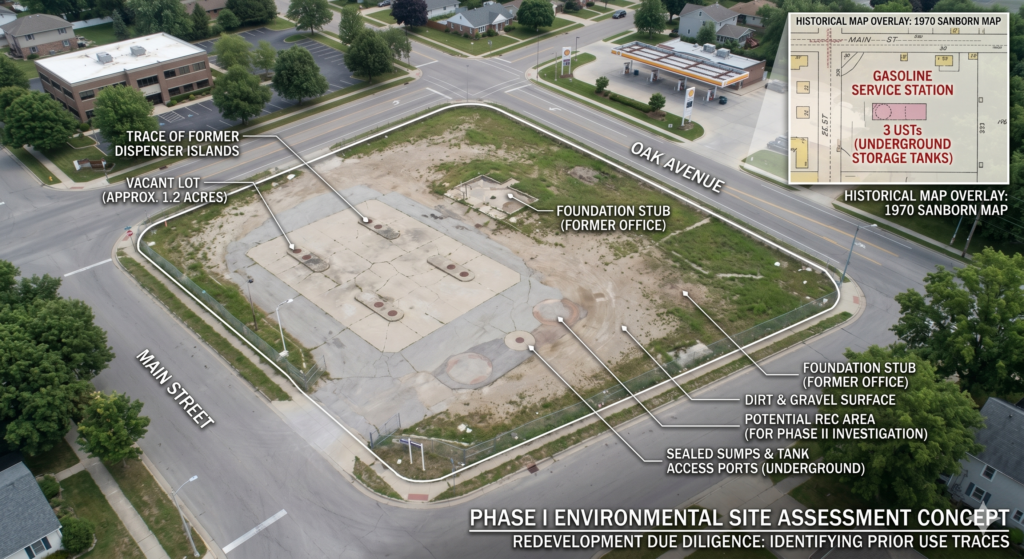
A former dry cleaning operation involves solvents that migrate through soil and groundwater in ways that require significant remediation before a site is developable. Underground storage tanks from former fuel operations carry their own mitigation requirements. Neither shows up on a boundary or topographic survey. Both show up in a Phase I Environmental Site Assessment, the formal instrument that documents a site’s historical use and identifies recognized environmental conditions before you’re committed to addressing them on your dime.
The Go/No-Go Question To Ask:
What was on this site before, and has a Phase I been completed?
Upstream work protects the pro forma.
Top developers don’t absorb surprises. They have a team responsible for surfacing these answers before a deal is finalized and pre-construction begins. That level of support is built for projects at a scale most first development deals don’t reach.
What your first deal does require is a fractional version of that same thinking—a targeted feasibility read that carries these four questions through due diligence.
Skip this step, and you’re moving forward on assumptions. Capture it early, and you’re making decisions with real footing. A documented assessment that reveals what the site is carrying before you commit is a strategic investment—one that can save you thousands ahead of detailed design.
If you are preparing to evaluate your first development site, this is the conversation worth having before you go under contract. Let’s connect.

Comments